Pollutants Management
Management of Pollution Incidents
Hyundai Steel reinforces the management of pollutants for the safety of employees and consumers. Thorough management of pollutants enables us to conduct preliminary reviews of pollutants associated with research or product use, and to establish processes to prevent pollution incidents. Furthermore, the Company carries out periodic emergency response drills and environmental inspection activities in preparation for pollutant incidents and is planning to participate in training by specialized institutions.
Prevention and Management of Pollution Incidents
Hazardous Chemicals
Hyundai Steel provides annual training on hazardous chemical substances in order to prevent accidents involving hazardous chemicals. In addition, departments using hazardous chemicals participate in the emergency response training at least once a year. We are also planning to take specialized training courses on chemical accidents provided by the National Institute of Chemical Safety for the purpose of reinforcing our capabilities to prevent and respond to chemical accidents.
Environmental Inspection
Hyundai Steel implements an environmental inspection plan to prevent air and water pollution which includes the operation of environmental facilities and equipment in compliance with the laws and the strict control of pollutants. The Company addressed 120 issues found during the inspections in 2021 and, as such, is doing its best to prevent pollution incidents.
Air Pollution
Hyundai Steel takes a preemptive approach to air pollution by putting in place systems for air quality management and decreasing air pollutant emissions. For this, the Company reinforces collective actions to address air pollution under MOUs with specialized agencies and also earnestly fulfills reduction agreements by improving air pollutant emitting facilities.
Improvement of Air Pollution Prevention Facilities and Efficiency
Hyundai Steel improves air pollution prevention facilities and their efficiency for the purpose of decreasing fugitive dust from our steelworks. We inspect precipitator, dust collecting ducts and hoods, to increase capacity and functions for efficiency regarding dust collection. We diagnose the capacity of dust collecting facilities periodically, such as pressure, flow velocity and dust concentration of each element, and use tools that analyze pressure loss and flow to set directions for improvement. Immediate fix is made through maintenance and repair, and issues requiring construction and investment are addressed by allocating a budget for the following year. With that, Hyundai Steel seeks to improve the work environment, reduce fine dust, and seeks to turn itself into an eco-friendly steel maker through continuous on-site inspection, diagnosis, improvement, and investment.
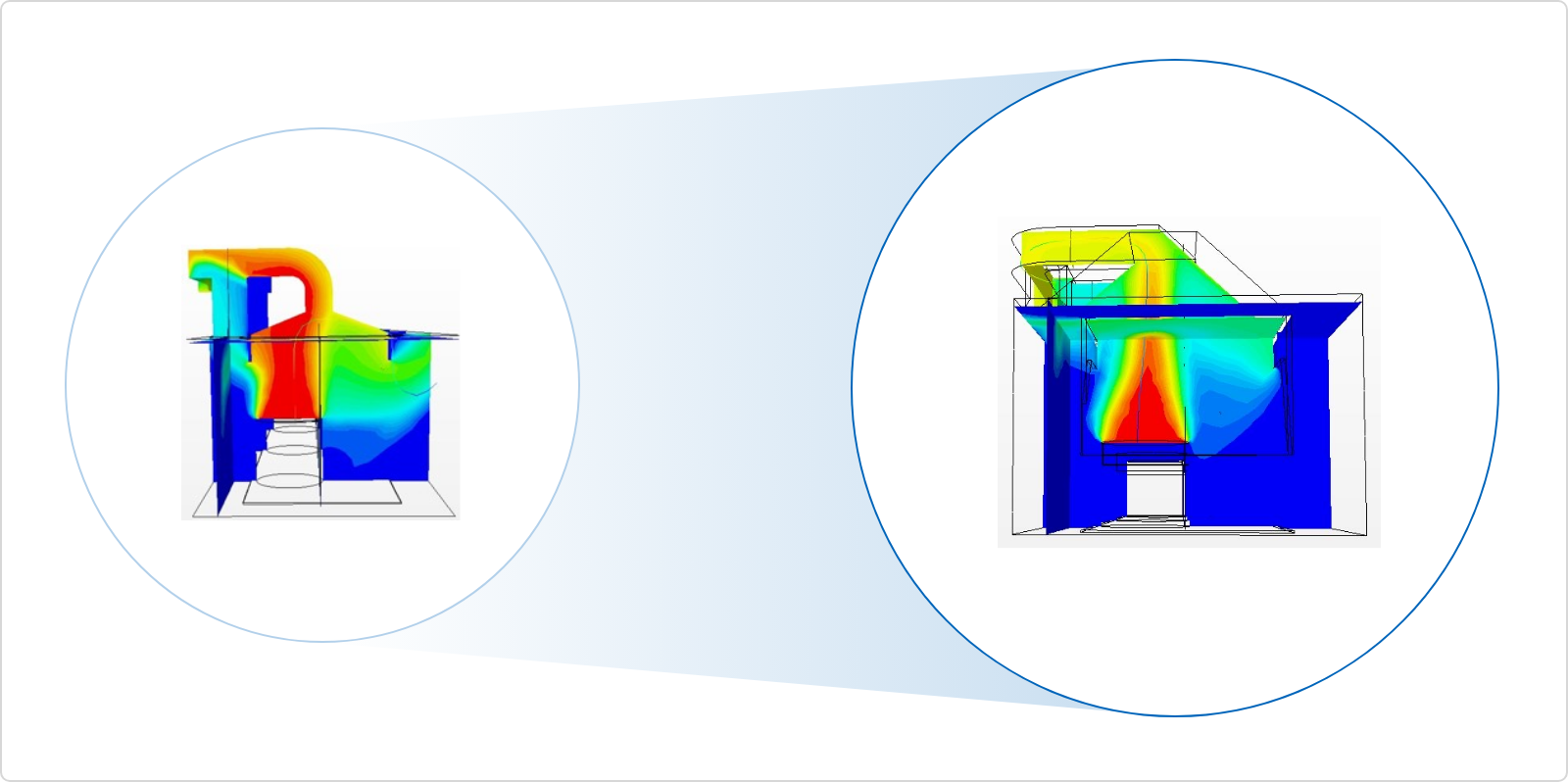 Efficiency improvement of air pollution prevention facilities
Odor Management at Dangjin Integrated Steelworks
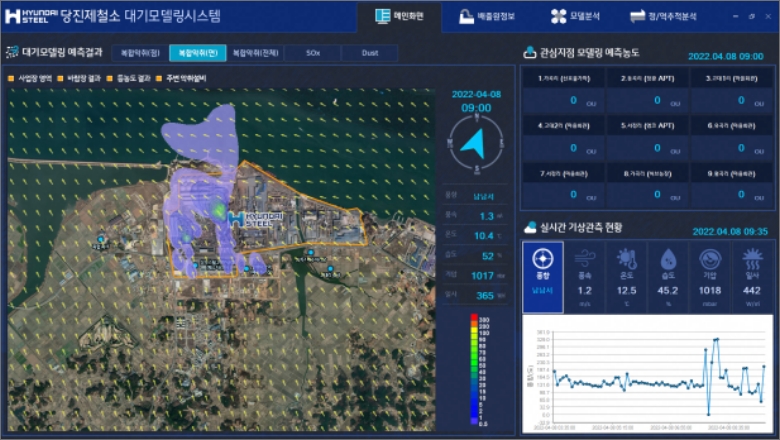
Due to increasing civil complaints about odors in Korea, local governments have been tightening regulations on order management. Under these circumstances, Hyundai Steel is making investments in facilities decreasing odors and building monitoring systems and modeling programs to analyze the causes of odors and the path of diffusion. In particular, we are investing about KRW 3.4 billion to improve odor prevention facilities at major sources of odors, and from the first half of 2021, odor monitoring devices started operating at three locations on the boundaries of our business sites. The odor monitoring devices measure complex odors and designated odors(hydrogen sulfide, ammonia, and volatile organic compounds) in real time, and complex odor data is disclosed on the website of Chungcheongnam-do Province in real time. We expect to reduce odor emissions through continuous investment in environmental facilities, and to effectively manage odors, analyze causes, and prepare countermeasures through constant monitoring.
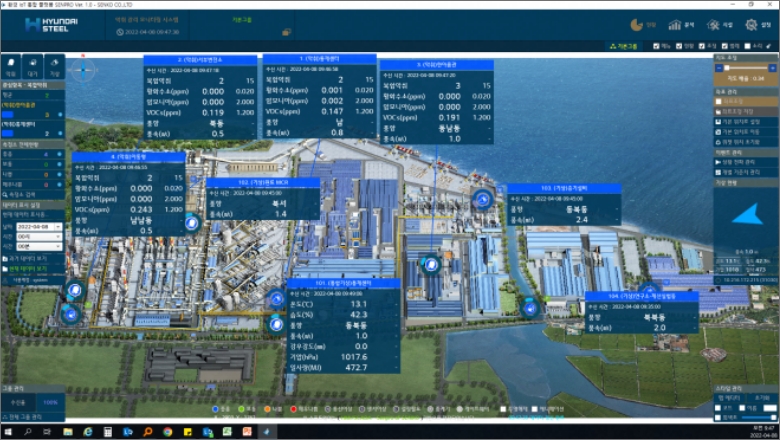
 Odor monitoring system
Odor modeling
Odor monitoring system
Odor modeling
Agreement on Voluntary Reduction of Air Pollutants
Hyundai Steel plans to actively reduce pollutant emissions by entering into an agreement with Dangjin City on voluntary reduction of air pollutants. In 2017, Dangjin signed an agreement with 22 business sites(Class I) for voluntary reduction of air pollutants, whereby they agreed to cut air pollutant emissions by more than 20% by 2022, compared to 2016, in order to improve local air quality, and as a result air pollutant emissions declined by over 70%. Now, Dangjin is planning on the second agreement and this time the scope will be expanded to 42 business sites, including Class II business sites. Among the participants, those who have already signed a voluntary air pollutant reduction agreement with Chungcheongnam-do Province and are subject to the total emission load control system, will reduce emissions more than 43% by 2024 compared to their 2020 quota. The other business sites are planning on 10% reduction or more, compared with their average emission in 2019 or 2020, considering the challenging business environment due to the COVID-19 pandemic. In addition, these participant companies will preferentially choose eco-friendly vehicles, such as electric or hydrogen vehicles, when sourcing business vehicles and strive to build in-house electricity and hydrogen charging infrastructures. Dangjin will provide administrative support to help them reduce air pollutant emissions.
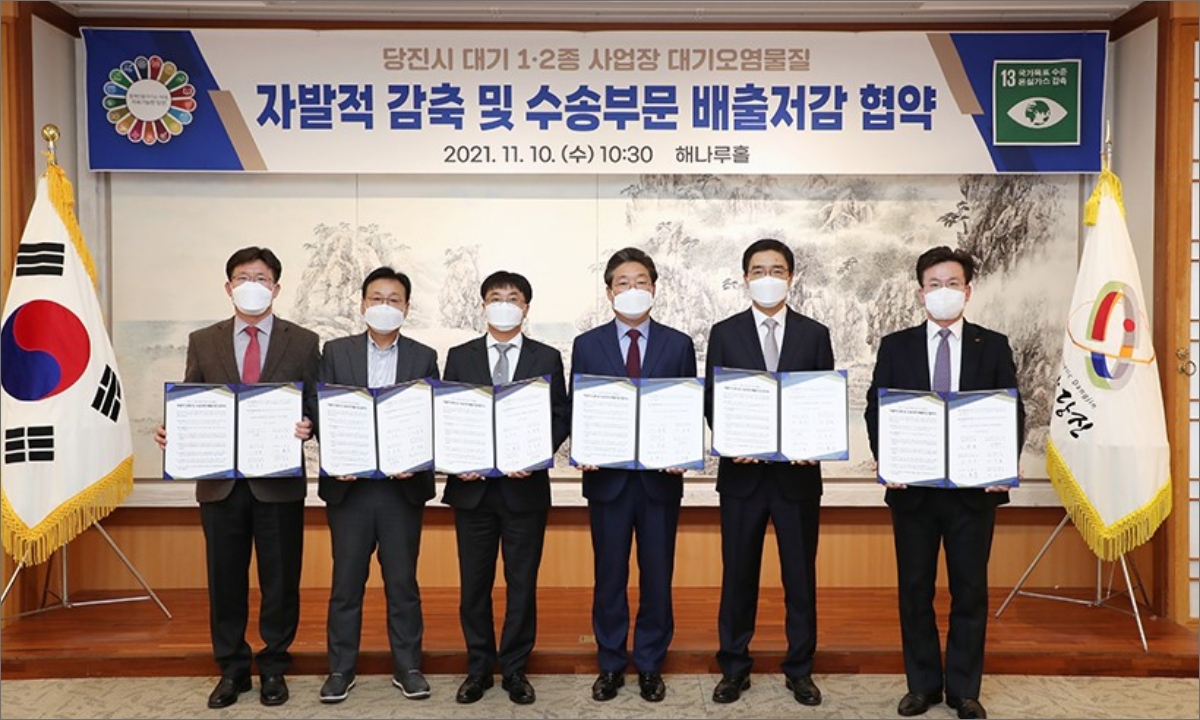 Signing ceremony of the agreement on voluntary reduction of air pollutants
Agreement on Voluntary Reduction of High-concentration, Seasonal Fine Dust
With a view to protecting public health and reducing fine dust during the seasons of high fine dust concentration(December ~ March) and when the government issues emergency reduction measures, Hyundai Steel signed an agreement with the Ministry of Environment, whereby we will apply stricter emission concentration standards and optimize the operation of fine dust prevention facilities when fine dust concentration is high, and install optimal NOx emission prevention facilities early.
Departments related to fine dust have entered into an emergency mode at our business sites during the seasons with high fine dust concentration since 2019. In case emergency reduction measures are issued, we strive to improve air quality based on our manuals.
Water Pollution
Hyundai Steel is engaged in activities to manage water quality and reduce water consumption throughout the value chain. We also take part in international efforts to protect water resources. Moreover, we strive to improve water quality and the ecosystem to avert possible disruption in production due to water shortage.
Preemptive Response to Changing Organic Substance Indicator of Effluent
Hyundai Steel prepares measures to reduce TOC1) of the Dangjin Integrated Steelworks. We estimate the replacement cycle for activated carbon and consider introducing activated carbon regeneration facilities in order to stabilize the water quality of the effluent. In 2020, the organic substance indicator of effluent was changed from COD2) to TOC, which measures more than 90% of entire organic substances, and accordingly the Company has adopted TOC as a new indicator to monitor at the Dangjin Integrated Steelworks. While the legal requirement is to install TOC TMS by June 2023, TOC TMS was already installed at our electric arc furnaces and #1 cold rolling in 2021, and will be installed at the wastewater treatment facilities in 2022. As such, we plan to start TOC monitoring early so as to reinforce the management of non-biodegradable organic substances.
- 1) Total Organic Carbon(TOC): the amount of carbon found in an organic compound causing water pollution, used as an indicator of water quality
- 2) Chemical Oxygen Demand(COD): a method of measuring the amount of organic substances in water pollutants. It measures the number of oxidants consumed by reacting with organic substances including permanganate, giving out the result as oxygen consumption. However, there is a limitation that not the result as oxygen consumption.
Integrated Management of Effluent-treating Chemicals at Dangjin
Hyundai Steel compares and reviews the cost of water treatment for each process by calculating the monthly amount of pollutants removed and chemicals used at the 11 water treatment facilities at the Dangjin Integrated Steelworks. This analysis enables us to optimize the management of these facilities to reduce environmental hazards from the use of chemicals and maintain stable effluent concentrations. For Biological Effluent Treatment(BET)3), which has a relatively high unit cost compared to other methods, we conducted on-site assessment, and apply final consumption targets. The use of chemicals decreased by 50% to 6.5 tons/day in 2021 and will be further reduced to an optimal amount. Going forward, we will continue to compare and manage our levels of chemical use and pollutants at our wastewater treatment facilities to reduce environmental hazards while at the same time maintaining stable effluent water quality.
- 1) BET: A biological wastewater treatment in which harmful suspended matters settle into mud.
Water Risk Management
Water Management Roadmap
Aware of the importance of water resources, Hyundai Steel preemptively responds to the risk of water shortage by implementing a mid- to long-term water management plan. In order to minimize the risk of water shortage, we have entrusted the operation of the 'water supply & drainage system' of Dangjin Integrated Steelworks to Korea Water Resources Corporation(K-Water) since the steelworks was constructed. This enables us to immediately respond to seasonal risks relating to water resource as well as ensure the effective operation and maintenance of water supply and drainage facilities.
-
Stabilization(~2018)
-
Water resources
-
Expand the water purification plant (Phase 2) in Asan
- · Intake source: Lake Asan
- · Facility capacity: Residential 59,000m3/day
Industrial 90,000m3/day
-
Actualizing the industrial water agreement contract
- · Reduction by 40,000 tons/day
-
Expand the water purification plant (Phase 2) in Asan
-
Facility operation
- Standardize facility operation technology
- Focus on facility improvement and cost saving
- Actualize of consigned operation contract
-
Develop the competency of operating staff
- · Facilitate job training/group activities
-
Environment
- Comply with the standards of environmental impact assessment
- · Focus on COD reduction and stabilization
-
Water resources
-
Optimization(~2020)
-
Water resources
-
Expand the water purification plant(Phase 3) in Asan
- · Intake source: Lake Asan, Lake Daecheong
- · Facility capacity: Industrial 100,000 m3/day
-
Save water by introducing advanced technology
- · Research evaporation/sprayed water recovery method
-
Expand the water purification plant(Phase 3) in Asan
-
Facility operation
-
Optimize facility operation
- · Compile operating technologies
-
Foster experts in facility operation
- · Secure distinctive operational technology
- Maximize cost reduction
-
Optimize facility operation
-
Environment
-
Actively introduce advanced technologies
- · Processing method, equipment, management method
-
Actively introduce advanced technologies
-
Water resources
-
Advancement(2023~)
-
Water resources
-
Solve water shortage
- · Review solutions to long-term water shortage
- · Create a close collaboration system with the supplier(K-water)
-
Solve water shortage
-
Facility operation
- Provide technology consulting to Hyundai Motor Group affiliates
-
Play the role of management technology leader in the industry
- · Provide technology consulting to SMEs in the steel industry
-
Environment
- Promote partnership with stakeholders
- Contribute to creating an eco-city and local communities ecological polis, and to the local community
-
Water resources
Reduced Water Consumption in Dangjin
Hyundai Steel has sought to reuse wastewater between plants as a way to reduce costs and secure competitiveness by minimizing water consumption and increasing wastewater reuse. Steel mills located in Dangjin Integrated Steelworks utilize scrubber water to collect dust and gas emitted during the process when molten iron is turned into molten steel in the blast furnace. Compared to cooling water directly sprayed on products during rolling in the heavy plate/hot rolling plants, scrubber water doesn't have to be of as good quality. Considering such factor, we sought ways to reuse the wastewater of the heavy plate/hot rolling plants for dust collection at the steel-making plant. In July 2021, the Company conducted piping and automation work to supply wastewater from the heavy plate plant to the steel mill and, from September, began to reuse the wastewater from the heavy plate plant, thus saving 540,000 tons of water per year(worth about KRW 600 million). With that, we expect to be able to contribute to the improvement of the water ecosystem for the local community by also reducing wastewater from the heavy plate process.
Management of Water-scarce Areas
The deterioration of the water quality of Lake Asan, which is the source of industrial water supply for Dangjin Integrated Steelworks, has been feared to reduce the efficiency of water supply and drainage facilities and disrupt industrial water production, which could negatively affect the operation of the steelworks. In January 2021, Korea Water Resources Corporation(K Water) completed the installation of pipelines to supply good quality industrial water by mixing water supply from Lake Daecheong, which is known to have better water quality than Lake Asan, in a bid to cope with increasing demand for industrial water around Dangjin, which enabled stable industrial water production at our facilities of the Steelworks. The Company will renew this water supply contract with K Water, thereby putting in place a system to decrease risks associated with water resource and cope with various issues in advance.
Chemical Substances
The amended「Chemical Substances Control Act」introduced more stringent regulations on facilities handling chemicals. In order to proactively respond to the regulation, Hyundai Steel joined the joint registration council and registered 43 chemical substances, and provide technical support for hazardous chemicals to our business sites.
Proactive Response to Chemical Regulations
Hyundai Steel is making preemptive responses to tightening regulations, such as the expanded list of chemicals required for registration and the regulation on management of facilities handling hazardous chemical substances. In 2021, we registered 18 substances, including coal tar, and plan to register another 20 chemicals by 2030. Furthermore, the Company established the environment management system, which also deals with chemical substances, in 2021, thereby improving efficiency in our environment-related activities. Sharing know-how with industry peers helped us to enhance our management of hazardous chemical substances. We will continue our efforts to minimize our environmental impact on local communities and settle down concerns related to environmental pollution.
Approval of Chemical Accidents Prevention and Management Plan
The revised「Chemical Substances Control Act」requires the chemical accidents prevention and management plan to take effect from April, 2021. In response, the Dangjin Integrated Steelworks merged a number of existing external impact assessments and risk management plans into a single chemical accidents prevention and management plan, which was then approved for conformity by the National Institute of Chemical Safety. Hyundai Steel will share such know-how of the Dangjin Integrated Steelworks to other place of businesses to help them receive conformity approval of their chemical accidents prevention and management plan, and will make steady efforts to ensure the safe management of hazardous chemicals.
Management of By-products
To comply with the government's circular economy policy and maximize the value of by-products as resource, Hyundai Steel integrated management of 24 tasks for by-product recycling and established a mid-to long-term plan. Furthermore, we set up the steering committee involving executives for more efficient cooperation and reporting.
Improvement of Integrated Management of By-product Recycling
Hyundai Steel established the by-product management system that connects the working level consultative body, management committee and the CEO, and implemented a total of 24 tasks for by-product recycling in an integrated manner. As a result of implementing short-term tasks slated for completion by 2021, we saved cost of about KRW 22.4 billion, developed a substitute for fluorite, and obtained an approval on the use of shell in our steel mills in the environmental assessment of recycling. We will further improve the integrated task management, by adding new tasks, merging existing tasks, and re-setting directions, in order to maximize performance and raise efficiency, and implement 16 tasks.
Shells Used as Substitute for Limestone in Steelworks
Hyundai Steel strives to build a circular economy by recycling discarded shells 1) as a secondary material. Approximately 35 million tons of shells generated across Korea every year are left unattended as there are no particular ways to dispose of them. As a result, discarded shells have been a source of environmental pollution, such as dust and stench. In response, Hyundai Steel has been developing a technology to use shells in the sintering process since 2014, and confirmed its potential as a substitute for limestone through test operation. In September 2021, shell recycling was approved by the environmental assessment of recycling which evaluates impact on the environment and human health, as well as technical feasibility. Shell recycling means a virtuous circle of waste resources, which lets us save raw materials cost and reduce GHG emission, by replacing limestone, a natural ore.
In collaboration with a supplier, Hyundai Steel conducted the life cycle assessment(LCA) on shell recycling in the sintering process and analyzed its impact on the steelmaking process. We found utilizing shell helps to reduce CO2 emission from the sintering process by 2.2%, compared to limestone, and also confirmed CO2 can be reduced more than 10% when the amount of shells was steadily increased to an extent possible considering operational stability and shell availability. We are planning to increase shell recycling in phases and turn shells into quicklime to be used in the sintering and steelmaking processes. As such, we will maximize the usage and value of discarded shells.
-
(Supplier) Delivery of raw materials
-
(Supplier) Processing
-
(Hyundai Steel) Sintered ore production
-
(Hyundai Steel) Delivery of shell limestone
- 1) Shells: Oyster and clam shells
Development of Subsidiary Raw Materials for Fluorite
Hyundai Steel collaborated with Samsung Electronics and developed a technology to re-use wastewater sludge produced during the semi-conductor manufacturing process as a secondary raw material for the steelmaking process.
Generally, fluorite1) is utilized to remove the impurities (sulfur, Phosphorus) in the steelmaking process more easily. This research was conceived from the fact that wastewater sludge from the semi-conductor manufacturing process has a similar substance (calcium fluoride, CaF2 50~60%) to that of fluorite. The tech centers of both Hyundai Steel and Samsung Electronics successfully developed a subsidiary raw material to replace fluorite by combining slag from secondary refining and sludge, and completed verification tests. This briquetted, secondary raw material is made by combining slag from second refining which lowers the melting point and semiconductor sludge which improves refining capacity. In April last year, we succeeded production of steel products by using 30 tons of prototypes and verified its safety. As a result, the Company acquired an approval in the environmental assessment of recycling by the National Academy of Environmental Sciences. This joint project is evaluated as a leading example of ESG management, recycling by-products through collaboration between the steel making industry and the electronics industry. It was also selected by the National Institute of Environmental Research to be the best practice ever since the recycling environmental assessment was launched in 2016. Hyundai Steel was able to reduce the purchasing cost of Fluorite, a material that had high dependency on imports.
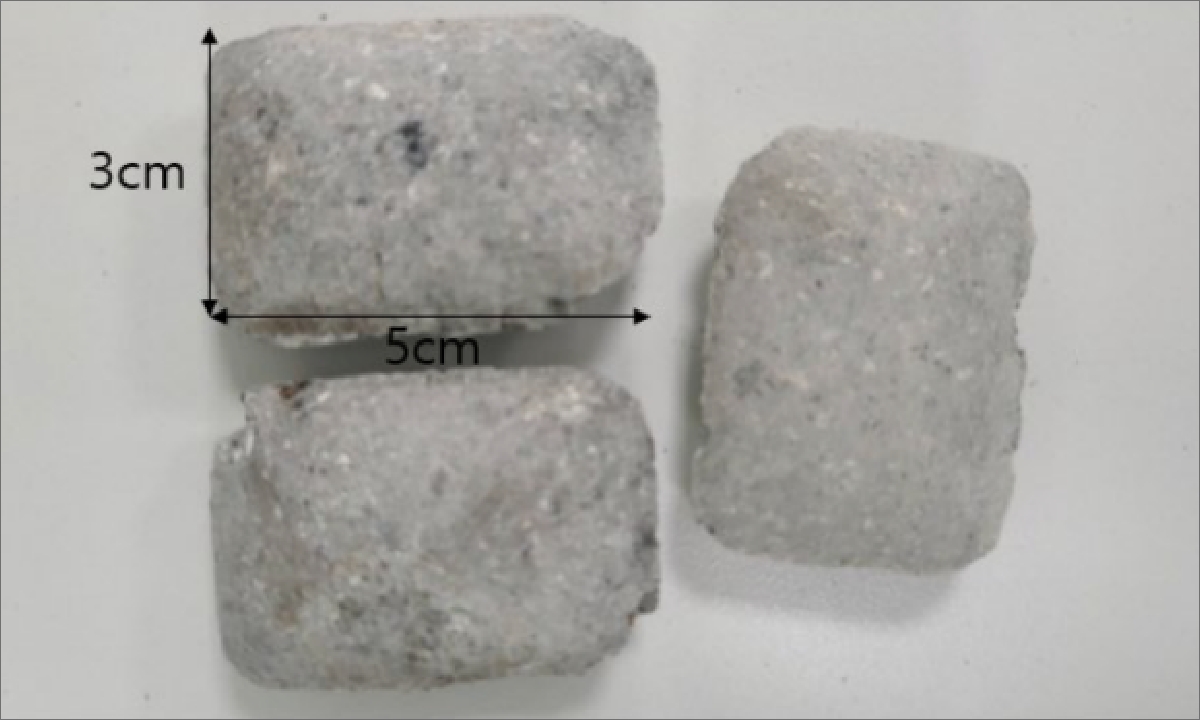 Fluorite replacement recycled from wastewater sludge
- 1) Fluorite: It is a natural ore(CaF2) imported and used in the steel making process in order to facilitate liquefaction by lowering the melting point of quicklime and slag, thus speeding up the removal of impurities.